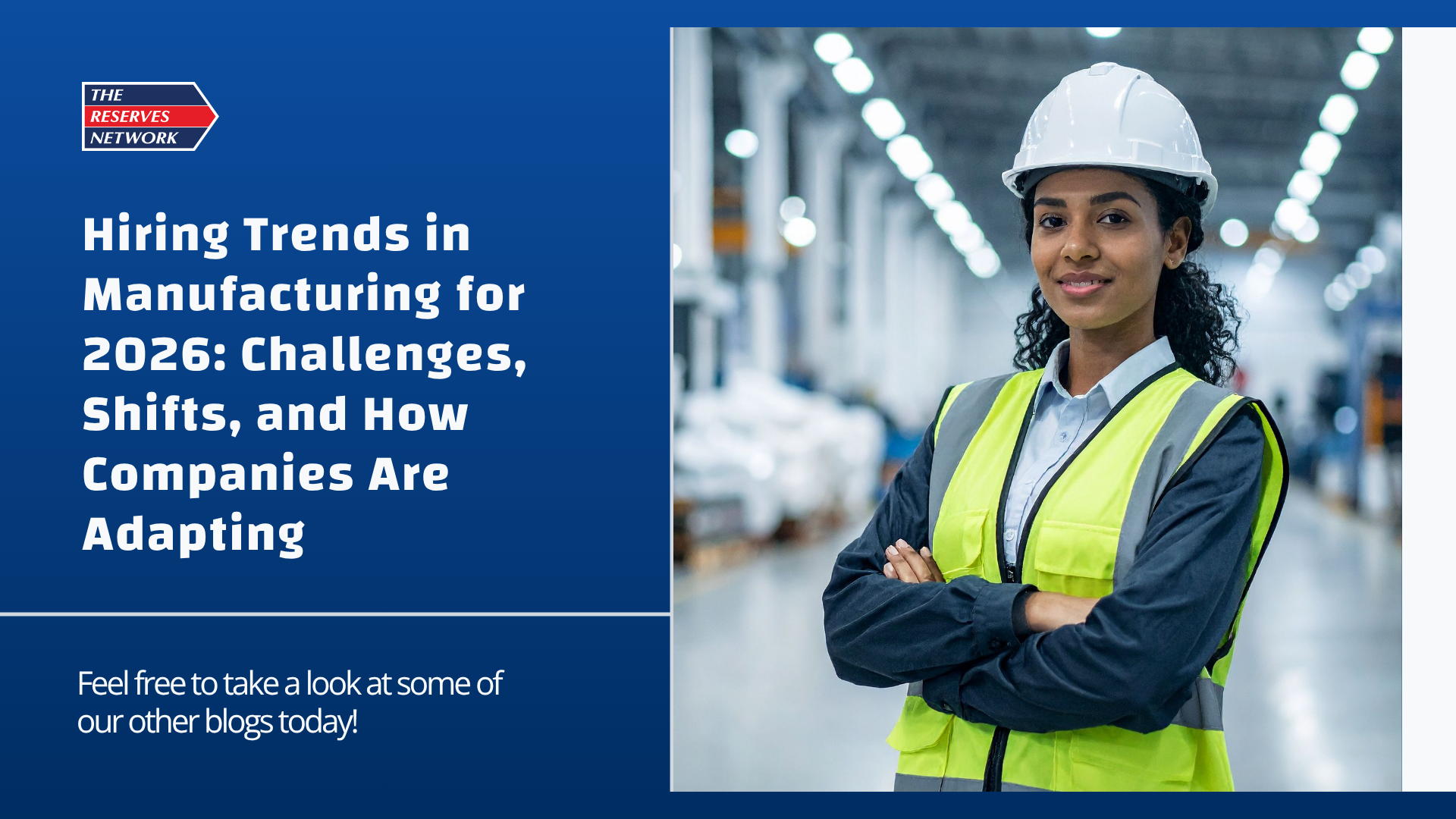
Hiring Trends in Manufacturing for 2026: Challenges, Shifts, and How Companies Are Adapting

The manufacturing industry continues to evolve rapidly in 2026. While many organizations entered the year cautiously optimistic, ongoing economic uncertainty, geopolitical tensions, and workforce shortages are continuing to shape hiring decisions across the sector.
Manufacturers are being forced to balance cost control with growth initiatives, all while competing for increasingly specialized talent. So what are the biggest hiring trends shaping manufacturing in 2026, and how are companies adapting?
1. Skilled Labor Shortages Are Still a Major Challenge
Despite advances in automation and AI, manufacturing remains heavily dependent on skilled workers. Companies across the industry continue to struggle filling roles in:
- Maintenance & reliability
- CNC machining
- Engineering
- Supply chain & logistics
- Quality assurance
- Production leadership
- Skilled trades
- Accounting, finance and IT support within manufacturing operations
A large portion of the experienced workforce is nearing retirement age, while fewer younger workers are entering the trades at the pace needed to replace them.
How Companies Are Responding
Organizations are investing more heavily in:
- Apprenticeship and internship programs
- Technical school partnerships
- Internal training and upskilling
- Cross-training employees across functions
- Retention initiatives focused on culture and career growth
Many employers are also becoming more flexible on experience requirements if candidates demonstrate strong adaptability and willingness to learn.
Companies are also realizing that speed matters more than ever in hiring. In many cases, partnering with recruiting firms that specialize in manufacturing and skilled trades is helping organizations access talent faster in an increasingly competitive market.
2. Economic Uncertainty Is Slowing Hiring Decisions
Interest rates, fluctuating consumer demand, and concerns about a potential slowdown have caused many manufacturers to take a more cautious approach to hiring.
Instead of aggressive headcount growth, companies are being far more strategic with:
- Replacement hires
- Workforce planning
- Compensation budgets
- Long-term labor costs
In many cases, hiring processes are taking longer because leadership teams want greater certainty before approving new positions.
How Companies Are Responding
To manage risk, manufacturers are:
- Prioritizing high-impact positions
- Using contract or project-based talent where appropriate
- Leveraging workforce data to forecast labor needs
- Consolidating responsibilities into more hybrid roles
At the same time, companies know they cannot afford to lose strong talent in a competitive market, creating a difficult balancing act between caution and urgency.
3. Geopolitical Issues Are Reshaping Supply Chains – and Hiring Needs
Global conflicts, trade uncertainty, tariffs, and ongoing supply chain disruptions continue to impact manufacturing operations in 2026.
Many organizations are reevaluating global sourcing strategies and shifting toward:
- Nearshoring
- Domestic production expansion
- Supplier diversification
- Inventory risk management
As a result, demand has increased for professionals with experience in:
- Procurement
- Supply chain analytics
- Inventory planning
- Operations strategy
- ERP systems and process improvement
How Companies Are Responding
Manufacturers are increasingly looking for candidates who can operate in complex, fast-changing environments. Problem-solving ability and adaptability are becoming just as important as technical experience. Companies are also investing more heavily in technology that improves visibility across operations and supply chains.
4. Automation and AI Are Changing the Workforce
Automation is no longer viewed as optional for many manufacturers, it has become necessary for efficiency and competitiveness. However, automation is not eliminating hiring needs. Instead, it is changing the types of roles companies need to fill.
There is growing demand for employees who can:
- Work alongside advanced technology
- Interpret operational data
- Manage automated systems
- Improve manufacturing processes
- Support digital transformation initiatives
How Companies Are Responding
Forward-thinking manufacturers are focusing on reskilling existing employees rather than replacing them.
The companies seeing the most success are those positioning technology as a tool that supports employees, not one that replaces them entirely.
5. Retention Has Become Just as Important as Recruiting
In today’s manufacturing environment, replacing experienced employees is expensive and time-consuming. As a result, retention strategies are becoming a major focus in 2026.
Employees are placing greater value on:
- Stability
- Leadership transparency
- Work-life balance
- Career advancement opportunities
- Competitive compensation
- Strong company culture
How Companies Are Responding
Manufacturers are paying closer attention to employee engagement and manager effectiveness.
Many organizations are also improving communication around:
- Career paths
- Internal promotions
- Performance expectations
- Long-term company strategy
Companies that create clear growth opportunities are seeing stronger retention and more successful recruiting outcomes.
Final Thoughts
The manufacturing hiring market in 2026 remains competitive, complex, and highly relationship-driven.
Economic pressures and geopolitical uncertainty are forcing organizations to be more strategic than ever, but companies still need strong talent to maintain productivity, support growth, and navigate operational challenges.
The manufacturers succeeding in today’s market are the ones investing in adaptability, whether through workforce development, technology, leadership, or culture.
Hiring in manufacturing is no longer just about filling positions. It is about building resilient teams that can perform in an unpredictable environment.