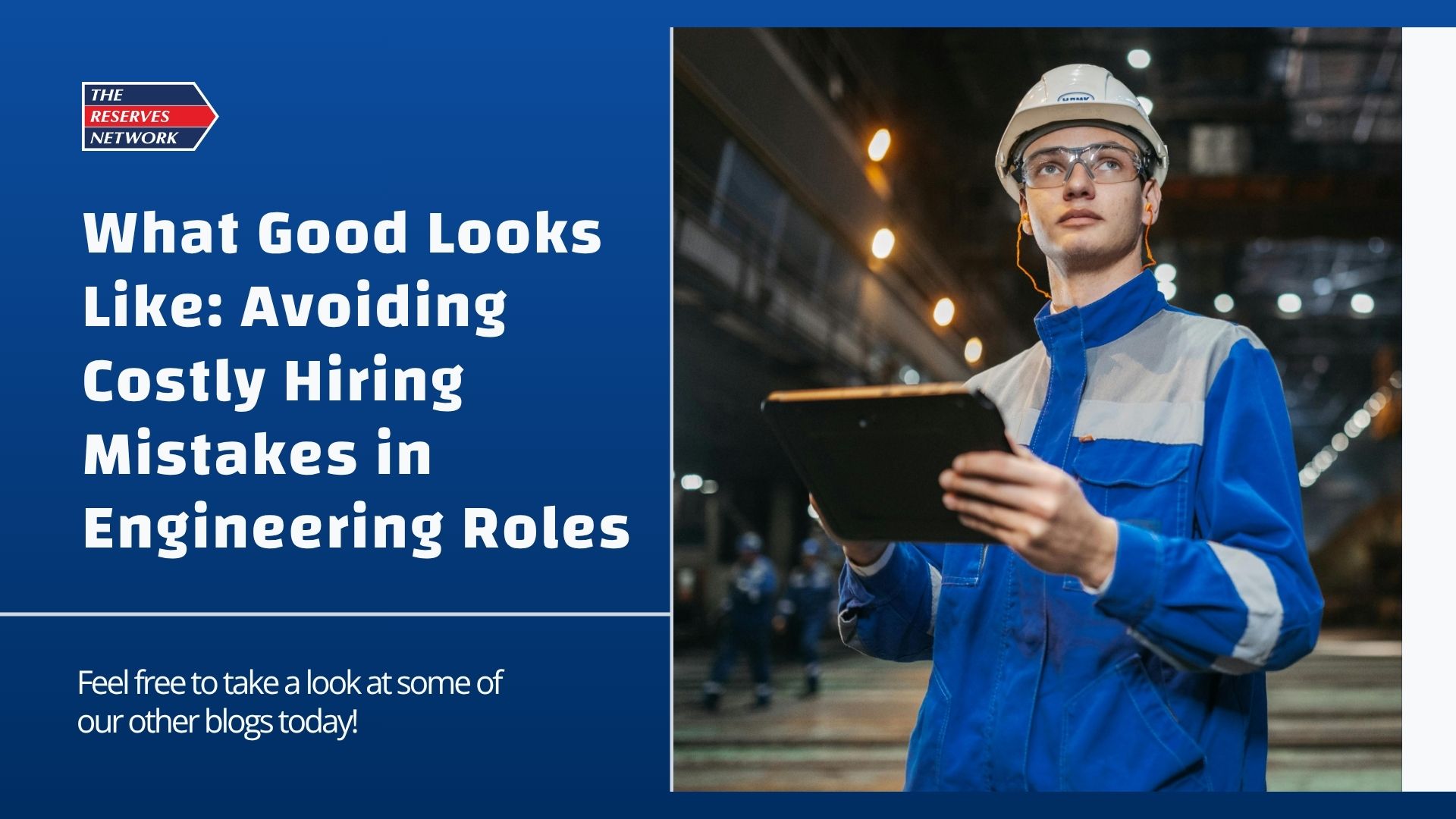
What Good Looks Like: Avoiding Costly Hiring Mistakes in Engineering Roles

Hiring engineers in today’s market is not just difficult. It is expensive to get wrong.
Across civil, industrial, mechanical, and related disciplines, the same issue shows up repeatedly. Companies are not struggling to find candidates. They are struggling to identify the right ones.
That gap leads to:
- delayed projects
- budget overruns
- team inefficiencies
- operational risk
At The Reserves Network, we work with companies every day that are trying to solve this exact problem.
The Real Problem Is Calibration
Most hiring challenges come down to one thing.
An unclear definition of what good actually looks like.
Job descriptions are often broad:
- Senior Engineer
- Project Engineer
- Design Engineer
But those titles can mean very different things depending on:
- Industry
- Project complexity
- Team structure
- Level of field involvement
Without clear calibration, hiring becomes inconsistent and costly.
The Most Common Hiring Mistakes We See
1. Overvaluing tenure instead of judgment
Years of experience do not always translate to capability.
We have seen candidates with more than ten years of experience who:
- Lack decision making experience
- Have not owned outcomes
- Struggle outside narrow scopes
We have also seen candidates with fewer years who operate at a much higher level.
What matters is applied judgment, not time in seat.
2. Hiring based on tools instead of thinking
Knowing tools like AutoCAD, Revit, SolidWorks, or PLC systems is expected.
It is not what defines a strong engineer.
The real difference is:
- How they approach constraints
- How they solve problems in real conditions
- How they make decisions under pressure
3. Ignoring field or implementation experience
This is one of the most expensive mistakes.
Engineers who have only worked in design environments often:
- Overlook constructibility
- Underestimate real world conditions
- Create issues during execution
Strong engineers understand how things actually get built, installed, or operated.
4. Vague role definition
When roles are not clearly defined, you attract the wrong candidates.
Key questions often go unanswered:
- Is this role focused on design or execution
- Does the role require client interaction
- Is the environment fast paced or long cycle
Without clarity, even strong candidates can be the wrong fit.
What Good Actually Looks Like
Across the engineering disciplines we support, strong candidates consistently show four traits.
1. They design for real conditions
They consider:
- Cost constraints
- Timelines
- Materials
- Regulatory requirements
Not just ideal scenarios.
2. They understand execution
They have seen projects through:
- Construction
- Manufacturing
- Field deployment
They know where problems occur and how to prevent them.
3. They make clear decisions
They can explain:
- Why a decision was made
- What alternatives were considered
- What risks were accepted
This is where true senior level thinking shows up.
4. They take ownership of outcomes
They do not just complete tasks.
They focus on:
- Whether the project works
- Whether requirements are met
- Whether future issues are created
Where The Reserves Network adds value
Many companies hesitate to work with a recruiting partner. That is understandable. But in today’s market, speed and accuracy matter more than ever. At The Reserves Network, our role is not just to send resumes.
We help clients:
1. Calibrate roles before the search begins
We define:
- What success looks like
- What level of experience is needed
- Where flexibility exists
This prevents a large percentage of hiring mistakes.
2. Identify real capability
We assess:
- Project experience
- Decision making ability
- Exposure to execution environments
Not just what is written on a resume.
3. Provide market insight
We give visibility into:
- Candidate availability
- Compensation expectations
- Hiring timelines
This allows faster and more informed decisions.
4. Reduce time to hire without lowering standards
Open roles cost money every day they remain unfilled. We help clients move faster while maintaining quality.
Final Thought
Engineering hiring is not just about filling a role.
It is about:
- Protecting timelines
- Controlling costs
- Ensuring successful outcomes
That starts with understanding what good actually looks like.
Once that is clear, hiring becomes more consistent and far less risky.
If you are hiring engineers and need clarity on the market or the role itself, The Reserves Network is actively supporting clients in this space today.